The hydraulic extruder pushes the Shelby tube sample onto the lab bench first thing in the morning. In Moncton, where the Petitcodiac River has shaped the valley floor, those thin-walled samples often come out with alternating layers of silty clay and fine sand. Our lab team cuts them into sections for consolidation and triaxial testing before the moisture changes. The soil mechanics study starts right there, with the physical handling of the material. We follow CSA A23.3 and NBCC 2015 classification procedures, adjusting the testing sequence based on what the extruded core reveals. Sometimes we see organic silt right at the surface, a remnant of the tidal marshes that used to cover parts of what is now Dieppe and downtown Moncton. The grain size analysis and Atterberg limits run in parallel, giving us the basic index properties within 48 hours for urgent foundation designs.
Missing the preconsolidation pressure in Moncton's upper clay layer can shift settlement calculations by 30 percent or more.
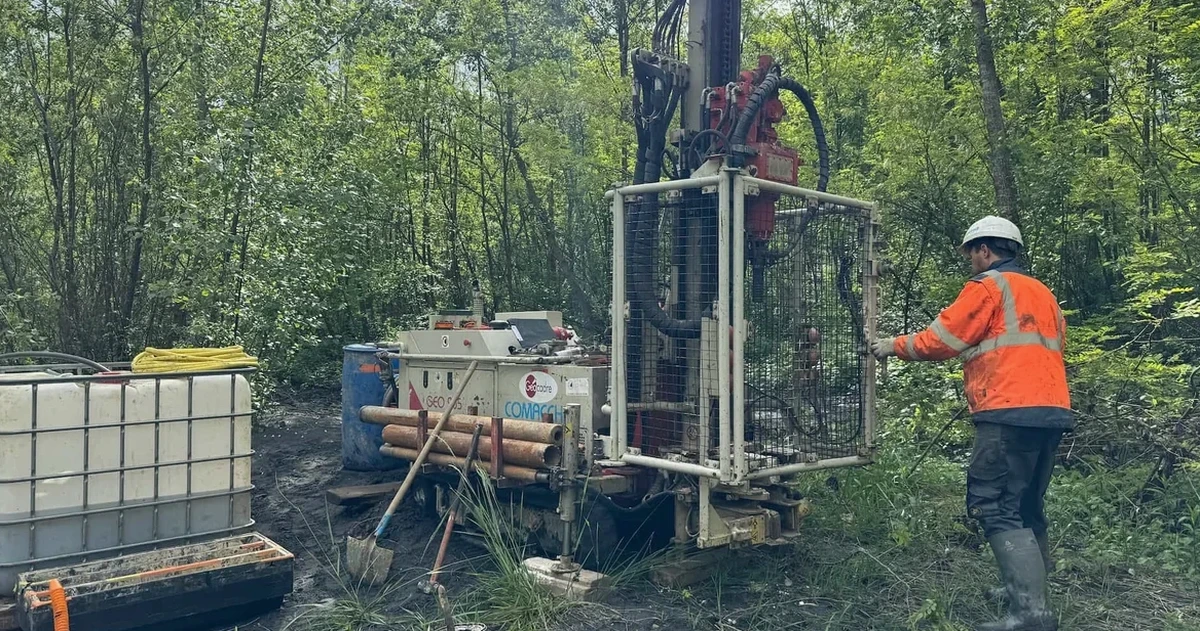
Technical details of the service in Moncton
Procedure video
Critical ground factors in Moncton
NBCC 2015 Article 4.2.4.1 requires that geotechnical investigations account for site-specific soil conditions, and in Moncton that means confronting the tidal bore legacy. The Petitcodiac River's historic tidal range deposited soft, compressible silts across the floodplain. Building on those deposits without a proper soil mechanics study leads to differential settlement that can crack masonry and rack door frames within the first five years. The gray marine clay found at depths of 3 to 8 meters across much of the city has a sensitivity that can exceed 8, meaning it loses significant strength when remolded. If excavation dewatering goes wrong, the base heaves and the adjacent ground settles. We also test for sulfate content in the groundwater because the Moncton area has pockets of gypsiferous shale that can degrade conventional Portland cement concrete. The lab runs pH and sulfate tests on water samples, and if concentrations exceed CSA A23.1 limits, the structural design switches to sulfate-resisting cement.
Our services
The soil mechanics study integrates several lab and field procedures to build a complete geotechnical profile for Moncton projects. Each test answers a specific question about strength, compressibility, or chemical aggressiveness.
Index Property Testing
We determine grain size distribution by sieve and hydrometer, Atterberg limits, natural moisture content, and organic content. These baseline tests classify the soil and flag potentially problematic materials like the organic silts found in the old Moncton marsh zones.
Strength and Consolidation
Direct shear and triaxial compression tests measure drained and undrained shear strength parameters. One-dimensional consolidation tests on undisturbed Shelby tube samples supply the compression index, recompression index, and preconsolidation pressure needed for settlement analysis.
Chemical and Durability Analysis
We test groundwater and soil for pH, sulfate content, and chloride concentration. In Moncton's gypsiferous zones, these results directly influence the concrete mix design and the selection of corrosion protection for buried steel elements.
Common questions
How long does a complete soil mechanics study take for a Moncton project?
Index properties like grain size and Atterberg limits are typically ready in 3 to 4 working days. Consolidation tests run 5 to 7 days because of the incremental loading schedule. Triaxial shear tests with pore pressure measurement take 7 to 10 days. A full package with consolidation, triaxial, and chemical analysis is usually delivered in two to three weeks from sample arrival at the lab.
What is the typical cost range for a soil mechanics study in the Greater Moncton Area?
For a standard suite covering index properties, consolidation, and triaxial shear on a few representative samples, the cost generally falls between CA$3,900 and CA$8,140. The final figure depends on the number of samples, the depth intervals, and whether chemical testing for sulfates or chlorides is required.
Which soil layers cause the most settlement problems in Moncton?
The soft gray marine clay that sits between 3 and 8 meters depth across much of the city is the main concern. It is normally consolidated to lightly overconsolidated, with a compression index that can exceed 0.3. If the preconsolidation pressure is misidentified, settlement predictions shift significantly. The organic silts near the surface in former marsh areas also compress under load and need to be removed or bypassed with deep foundations.
Do you test for sulfate attack on concrete in Moncton soils?
Yes. We run sulfate content tests on soil and groundwater samples as part of the chemical suite. Moncton sits on Carboniferous sedimentary bedrock that includes gypsiferous layers, and groundwater sulfate concentrations can exceed 1500 mg/L in some pockets. When they do, CSA A23.1 requires sulfate-resisting cement and a lower water-cement ratio to prevent ettringite expansion and concrete degradation.