The Petitcodiac River's tidal bore has shaped more than just Moncton's skyline—it carved out the soft, silty clays deposited by the ancient Champlain Sea that underpin much of the city. In our background, designing a retaining wall here means confronting groundwater perched just 1.5 to 3 meters below grade and a frost depth that reaches 1.2 meters. When a contractor calls about a cut on Wheeler Boulevard or a residential lot backing onto Halls Creek, the conversation starts with soil compressibility, not just wall height. A slope stability analysis often runs parallel to wall design because even a 2-meter excavation in these sensitive marine clays can trigger a retrogressive failure if not supported early. We combine NBCC 2020 seismic provisions with site-specific borehole data to size stems, heels, and reinforcement for walls that outlast the freeze-thaw cycles.
A retaining wall in Moncton lives or dies by its drainage—the Champlain Sea clay holds water like a sponge and swells the moment it thaws.
Technical details of the service in Moncton
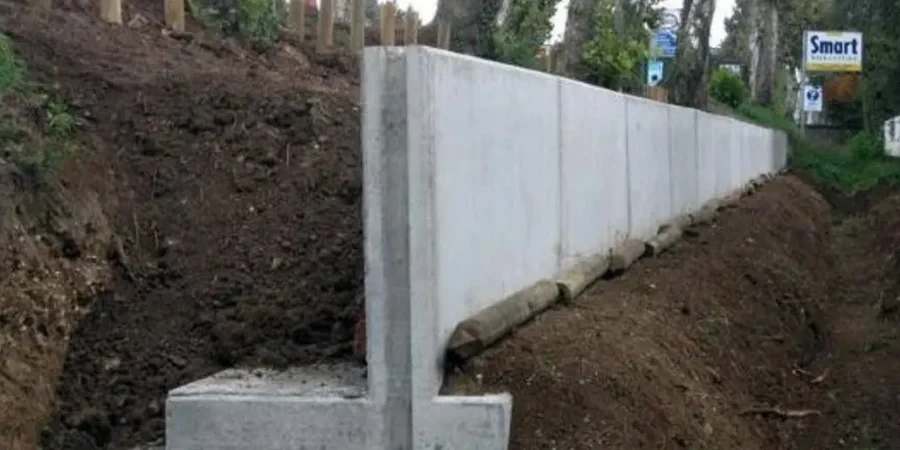
Critical ground factors in Moncton
Moncton’s growth spurt after the 1960s pushed residential subdivisions onto land that had been tidal marsh or poorly drained glacial plain. That history matters: we’ve pulled up borehole logs from the 1970s showing buried organic layers 4 meters thick under streets that now carry two-story homes. A retaining wall built without identifying those lenses ends up tilting within three winters. The biggest threat we see isn’t overturning—it’s differential settlement under the footing combined with hydrostatic buildup behind the wall. When a client opts out of site investigation, they’re gambling with a repair bill that can triple the original construction cost. We insist on at least one deep borehole per wall segment, and a in-situ permeability test when the drainage path is constrained by property lines or adjacent structures.
Our services
Our Moncton work spans from preliminary feasibility studies to stamped construction drawings. Every wall design starts with a geotechnical model built from site-specific data, not generic assumptions.
Cantilever and Counterfort Wall Design
Reinforced concrete walls analyzed for overturning, sliding, and bearing under NBCC load combinations. We detail stem thicknesses, heel and toe dimensions, and reinforcement schedules for walls up to 8 meters.
Mechanically Stabilized Earth (MSE) Walls
Design of steel strip or geogrid-reinforced systems with select granular backfill. We specify reinforcement length, vertical spacing, and connection details, plus internal and external stability checks.
Gravity and Modular Block Walls
Precast block and gabion walls for residential and municipal projects. We verify block interface shear, base width, and drainage, keeping wall sections within Moncton's frost protection requirements.
Common questions
What does retaining wall design cost in Moncton?
For a typical residential wall under 2.5 meters, design fees range from CA$1,530 to CA$5,000 depending on wall length, soil investigation needs, and whether stamped drawings are required for a building permit. Commercial MSE walls with full geotechnical reporting fall toward the upper end.
Do I need a geotechnical investigation before designing a retaining wall in Moncton?
Yes, and we consider it non-negotiable. The Champlain Sea clays and buried organic soils across Moncton vary dramatically over short distances. A site-specific borehole gives us undrained shear strength, groundwater depth, and settlement parameters—without it, the wall design is guesswork that NBCC doesn't endorse.
How do you handle frost heave in retaining wall footings?
We set footing bases at 1.2 meters minimum below finished grade, which is Moncton’s design frost depth per NBCC climatic data. Below the footing we specify a granular pad 150–200 mm thick to break capillary rise. For walls with unheated backfill, we also check the frost penetration angle behind the stem.
What retaining wall types work best with Moncton’s high water table?
Cantilever reinforced concrete and MSE walls both perform well when drainage is designed aggressively. We specify perforated toe drains, chimney drains, and free-draining backfill. Gravity walls with open joints—like gabions—can relieve hydrostatic pressure, but they still need a filtered base to prevent fines from piping through.