Moncton’s development along the Petitcodiac River has always been a battle with the mud. The city sits on a floodplain of deep, compressible silts and clays deposited by centuries of tidal bore action. That chocolate-brown river water signals serious geotechnical complexity underground. For any project with deep foundations, embankment loads, or excavation support in the Hub City, strength parameters from a generic correlation table won’t cut it. You need the actual friction angle and cohesion of the exact soil layer you’re loading. This is where the laboratory triaxial test comes in. The local geology here, shaped by the Moncton Sub-basin and post-glacial marine clays, demands precise effective stress analysis. We run ASTM D4767 and D7181 procedures routinely, and our team knows Moncton’s formations, from the stiff glacial till near Mapleton Park to the sensitive Leda-type clays downtown. A slope stability model is only as good as the triaxial data fed into it, and that’s a lesson we’ve learned from a decade of Moncton projects.
A single CU triaxial test on Moncton silt reveals more about foundation performance than fifty index classification tests.
Technical details of the service in Moncton
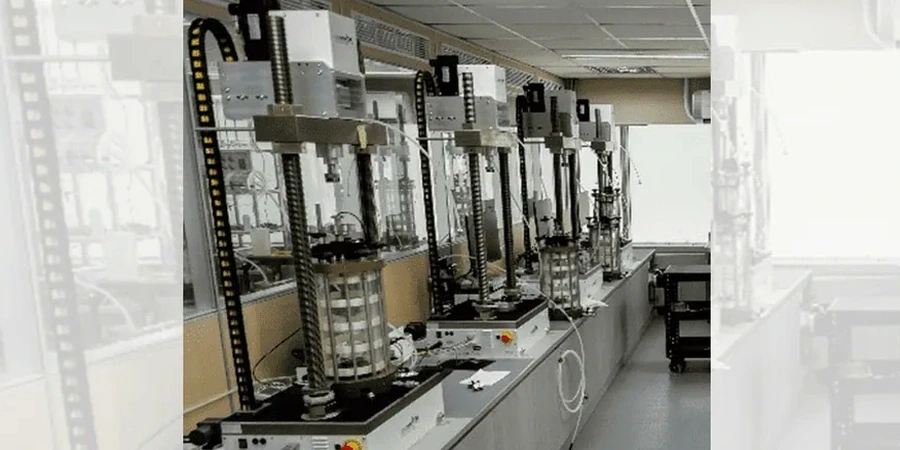
Critical ground factors in Moncton
The soils beneath Riverview’s sloping subdivisions behave very differently from the flat, compressible deposits under downtown Moncton. In Riverview, you have weathered sandstone and shale near the surface, and the triaxial test often shows a brittle failure mode with a pronounced peak strength. Downtown, the deep estuarine clays are normally consolidated and show contractive behavior: they generate positive excess pore pressure during undrained shear and lose strength. If you use Riverview’s friction angle for a downtown Moncton excavation design, you’re risking a base heave failure. We’ve seen the difference in the lab. The stress paths don’t lie. For Moncton’s flood-prone zones, we also assess post-peak softening. A strain-softening model calibrated with our triaxial data helps predict progressive failure in cut slopes along the riverbanks. Skipping the triaxial stage means designing blind to the soil’s true stress-strain response, and in Moncton’s sensitive clays, that risk translates directly to cost overruns and delayed permits.
Our services
Our Moncton laboratory runs triaxial programs tailored to the specific loading scenario and soil type. We configure the test to match your construction sequence, not just a generic standard.
Consolidated Undrained Triaxial (CU)
The standard choice for Moncton's low-permeability silts. We run three specimens with full pore pressure measurement, providing effective stress strength parameters c' and phi' and a stress path plot. Suitable for rapid loading conditions like foundation construction.
Consolidated Drained Triaxial (CD)
For long-term stability cases in Moncton: permanent retaining walls, bridge abutments, or cut slopes above the water table. Shear rate is slow enough to prevent any pore pressure buildup. Delivers the true drained friction angle.
Unconsolidated Undrained Triaxial (UU)
A quick total-stress test for preliminary assessments in saturated Moncton clays. We use this during early-stage site screening before a full CU program. Provides undrained shear strength Su for short-term bearing capacity checks.
Common questions
How long does a triaxial test program take for a Moncton project?
A standard CU triaxial set with three specimens typically takes 8 to 10 working days from sample receipt. The consolidation phase on Moncton’s low-permeability silts is the rate-limiting step: each specimen needs 24 to 48 hours to reach full pore pressure equilibrium. A drained test (CD) can extend to two weeks because the shear stage must run at a tenth of the CU rate.
What is the typical cost for a triaxial test set in Moncton?
A set of three CU triaxial tests with pore pressure measurement generally runs between CA$2,410 and CA$3,420, depending on sample quality and confining stress range. Drained tests (CD) are at the upper end of that range due to the extended shearing time. We always quote per program, not per specimen, after reviewing the Shelby tube condition.
Can you test Moncton's sensitive clays without disturbing them?
Yes. We use a thin-walled Shelby tube extrusion method and hand-trim the specimen in a controlled humidity room. For Moncton’s sensitive Leda-type clays, we minimize vibration during setup and apply a small seating load to avoid pre-shear. The specimen is then saturated using a back-pressure ramp that won’t disturb the natural structure.
What's the difference between CU and UU triaxial tests for our site?
A UU test runs without consolidation or pore pressure measurement and gives you an undrained shear strength, Su. It’s quick but only valid for short-term, total-stress analysis. A CU test consolidates the sample to the in-situ stress first, then shears it while measuring pore pressure. The CU result separates friction angle from cohesion in effective stress terms, which is what you need for any Moncton project with staged loading or permanent works.