The soil beneath Moncton tells two very different stories. In the northwest, toward the magnetic hill and newer subdivisions, you hit dense glacial till at relatively shallow depths. Head south toward the Petitcodiac River floodplain, and it's a completely different picture: 6 to 10 meters of soft, compressible silty clay sitting on loose alluvial sand. That contrast shows up in foundation costs, settlement risk, and construction timelines. Stone column design bridges that gap. We use vibro-replacement to install compacted gravel columns through soft strata, transferring structural loads to a stiffer composite ground mass. In the Dieppe industrial park and along the riverfront, where water tables sit barely a meter below grade, this technique has become the most practical alternative to deep piling. Proper design starts with a CPT test to map undrained shear strength and a grain size analysis of the native soil to confirm it will supply adequate lateral confinement to the columns.
In Moncton's riverfront clays, a well-designed stone column grid can cut primary settlement by 60 percent and accelerate consolidation from years to weeks.
Technical details of the service in Moncton
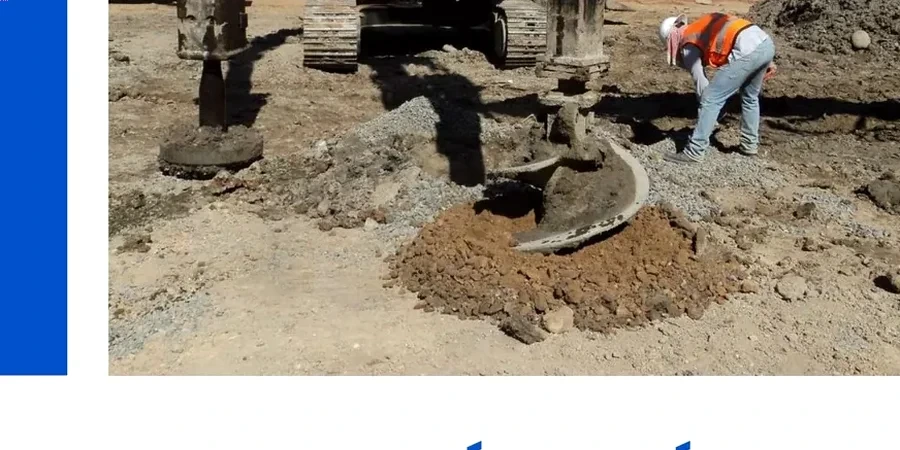
Critical ground factors in Moncton
In Moncton, we often see projects where the stone column contractor follows a generic grid layout without adjusting for lateral variability. The river channel migrated across the floodplain for thousands of years, leaving behind discontinuous lenses of peat and organic silt that a standard 2.5-meter grid won't catch. If a column terminates in one of these lenses without penetrating to competent material, it creates a soft inclusion that actually worsens differential settlement. We've pulled CPT logs from two boreholes 20 meters apart on the same lot that looked like entirely different soil profiles. The fix is simple: run enough soundings to map those lenses before finalizing the layout, and design columns with variable depth, not a uniform cutoff. A slope stability analysis also becomes relevant when stone columns are placed near the riverbank, where the improved zone can alter the failure surface geometry.
Our services
Our stone column design solutions in Moncton cover the full workflow from subsurface investigation through installation monitoring and load testing. Every project starts with site-specific characterization because the Champlain Sea deposits that dominate the Moncton basin are too variable for off-the-shelf solutions.
Geotechnical characterization and column layout
We map soft soil thickness and undrained shear strength across the site using CPT and select boreholes. The column grid, diameter, and depth are then designed to meet the project's total and differential settlement criteria under NBCC serviceability limits.
Installation supervision and QA/QC testing
Our team monitors column installation in real time, reviewing amperage and stone consumption logs against the design profile. Post-installation verification includes plate load tests on individual columns and CPT through the treated zone to confirm improvement.
Common questions
What does stone column design cost for a typical Moncton commercial lot?
For a commercial building pad in Moncton, stone column design including site investigation, analysis, and construction-ready drawings typically ranges from CA$2,090 to CA$8,040 depending on project size and subsurface complexity. Sites with irregular organic lenses or variable clay thickness require more investigation points and push costs toward the upper end.
How long does consolidation take after stone column installation in Moncton clays?
Stone columns act as vertical drains, reducing the drainage path length from meters to tens of centimeters. In Moncton's silty clays with a coefficient of consolidation around 2 to 5 m²/year, primary settlement that would take 2 to 3 years under a raft foundation typically completes within 4 to 8 weeks after column installation.
What soil conditions in Moncton make stone columns unsuitable?
Stone columns rely on lateral confinement from the surrounding soil. In Moncton, this becomes a problem in two situations: peat layers thicker than about 1 meter, which supply almost no confinement, and very soft clays with undrained shear strength below 12 kPa. We identify both conditions during the pre-design CPT investigation and recommend alternatives like rigid inclusions or driven piles when they dominate the profile.
Can stone columns be installed close to existing structures in downtown Moncton?
Yes, but with precautions. The vibroflot generates lateral vibrations that can affect adjacent buildings within about 10 to 15 meters. For tight downtown sites, we specify low-amplitude startup near the surface, monitor vibration with seismographs on neighboring foundations, and sometimes switch to a displacement auger method for the perimeter columns to stay within NBCC vibration limits.