The National Building Code of Canada references ASTM D4318 for fine-grained soil classification, and in Moncton that standard isn't optional paperwork. The Petitcodiac River floodplain and the weathered silts underlying the old Intercolonial Railway corridor create a patchwork of borderline soils where the difference between a lean clay and a fat clay dictates whether a footing drains or fails. Our lab team runs liquid limit and plastic limit determinations on every disturbed sample that shows fines, because plasticity index is what separates a routine excavation from a construction claim. Before breaking ground anywhere east of Wheeler Boulevard, pairing Atterberg results with a CPT sounding gives us the continuous profile that split-spoon recovery alone misses, especially through the compressible estuarine clays that run under the river terraces.
A three-point change in plasticity index can mean the difference between a lean clay that compacts and a fat clay that pumps moisture under load.
Technical details of the service in Moncton
Critical ground factors in Moncton
Moncton sits in a climatic tug-of-war between Bay of Fundy fog and continental freeze-thaw cycles, and that oscillation wreaks havoc on borderline plastic soils. We've seen excavations near the riverfront where a lean clay classified at PI 12 in September turned into unworkable muck by November simply because the natural water content crossed the liquid limit during fall rains. The real danger isn't misclassification on paper, it's what happens when a contractor places structural fill on a subgrade that the lab called low-plasticity silt but which field behavior says otherwise. A liquidity index approaching 1.0 means the material will flow under repeated loading, and that's exactly the condition we flag when Atterberg results for the reddish-brown tills along the Trans-Canada Highway corridor come back with moisture contents within striking distance of the plastic limit. In these cases we insist on correlating index tests with undrained shear strength before any foundation recommendation leaves the lab.
Our services
Every Atterberg limits report from our Moncton lab includes the full index suite with contextual interpretation tied to the specific formation the sample came from, because a plasticity index of 25 means something entirely different in the Petitcodiac alluvium than it does in the lodgement till of the Caledonia Highlands. Below are the testing configurations we run most frequently for projects across southeastern New Brunswick.
Standard Atterberg Limits Package
Liquid limit, plastic limit, and plasticity index on one disturbed sample per ASTM D4318. Includes moisture content and USCS classification. Suitable for routine site investigation boreholes in the Moncton metro area where clay mineralogy is well-characterized. Typical use: subdivision grading plans, shallow foundation verification, trench backfill acceptance.
Full Index Testing Suite with Activity
Complete Atterberg determination plus hydrometer grain-size analysis on the same sample to compute activity (PI/% clay). This is the package we recommend for the sensitive marine clays encountered in deep excavations near the river and for any project where the plasticity chart shows points close to the A-line. Includes liquidity index calculation when field moisture content is provided by the driller.
Common questions
What does Atterberg limits testing cost in Moncton?
For a standard liquid limit and plastic limit determination on one disturbed sample, the fee ranges from CA$100 to CA$140 depending on whether moisture content is included and if the sample requires wet preparation due to organic content. The full index suite with hydrometer and activity calculation sits at the upper end of that range. Bulk pricing applies for projects submitting ten or more samples from the same site.
How long does it take to get Atterberg results from the lab?
Our standard turnaround is 48 hours from sample receipt. For active construction sites in Moncton, Dieppe, or Riverview where excavation is pending on the results, we offer same-day rush service provided the sample arrives before 10 a.m. The limiting step is oven-drying; borderline organic soils sometimes need an extra drying cycle to reach constant mass before the liquid limit can be run.
Why do my Atterberg results not match what I see in the field?
The most common reason in the Moncton area is sample disturbance during transport, especially with the sensitive estuarine clays that lose structure when jostled. A remolded sample will show a lower liquid limit than the intact material. We also see discrepancies when the natural water content approaches the plastic limit; in those cases the soil behaves like a brittle solid in the field but the lab test captures the fully remolded condition. We flag these borderline cases and recommend field vane shear testing to confirm in-situ behavior.
Which Atterberg test method do you use and does it matter?
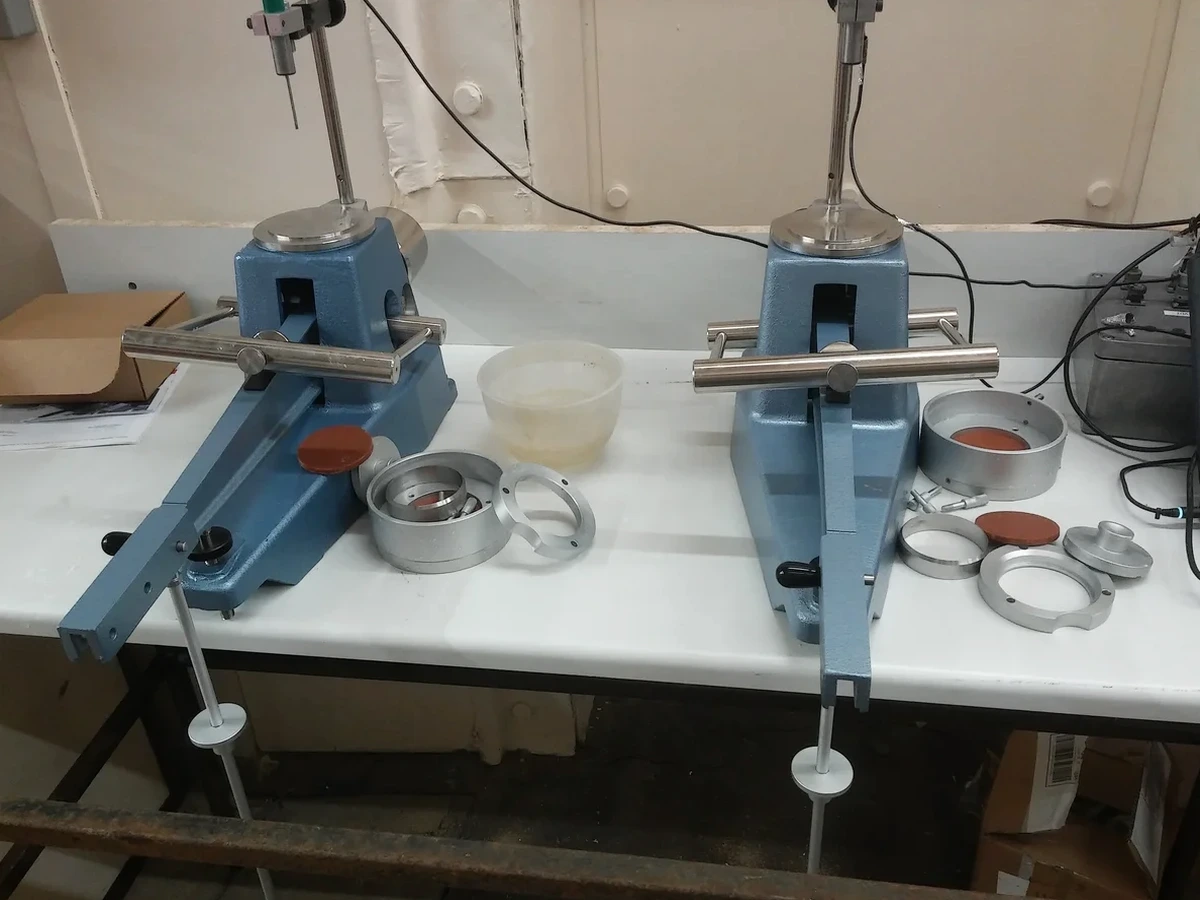
We run the Casagrande cup method per ASTM D4318 as our primary procedure because it remains the reference standard in Canadian geotechnical practice and matches what the NBCC expects. For organic silts and high-plasticity clays where the grooving tool tends to slide rather than cut a clean separation, we cross-check with the fall-cone method which gives a more reproducible liquid limit. The difference between the two methods can be 3 to 5 points on the liquid limit, and we report both values when the discrepancy exceeds that range.