Moncton's aggressive freeze-thaw cycles and the silty clays of the Petitcodiac River floodplain make anchor performance more than a textbook calculation. Every design must account for pore water pressure shifts in the spring melt and the low shear strength of the local Tantramar marsh deposits. Our engineering team applies this regional understanding from the first borehole log to the final stressing sequence. We don't just size a tendon; we calibrate the bond length to the actual stratigraphy encountered on your site, whether you're stabilizing a commercial excavation downtown or a bridge abutment near Dieppe. This approach ties directly into data from an Spt Drilling program, which gives us the granular N-value profile needed to set realistic anchor capacities. For deeper coastal projects, we also reference Cpt Test cone resistance data to refine the soil parameters in zones where the clay transitions to dense till.
In Moncton, a passive anchor driven into dense glacial till performs entirely differently than one grouted in the compressible estuarine clay—we design for that specific reality.
Technical details of the service in Moncton
Procedure video
Critical ground factors in Moncton
The lacustrine and marine clays underlying much of Moncton are prone to creep under sustained load. If the fixed anchor length is placed within these sensitive clays without adequate confinement, the tendon will lose load progressively—sometimes within the first 48 hours. A second, less obvious risk is anchor head corrosion in the splash zone near the tidal Petitcodiac River, where brackish water accelerates steel deterioration. We've pulled out anchors in the area where the bearing plate had thinned to half its original thickness in under ten years. Seismic demand under the NBCC 2020 adds another layer: a passive anchor that works under static conditions may see reversed shear during a rare event, requiring an entirely different unbonded length and tendon elongation capacity than what a standard simplified method would suggest.
Our services
Our Moncton anchor design scope covers the full execution cycle, not just the calculation sheet. We define the drilling method, the grouting pressure, and the stressing sequence so the contractor has a clear path from mobilization to lock-off.
Active Anchor Design & Stressing
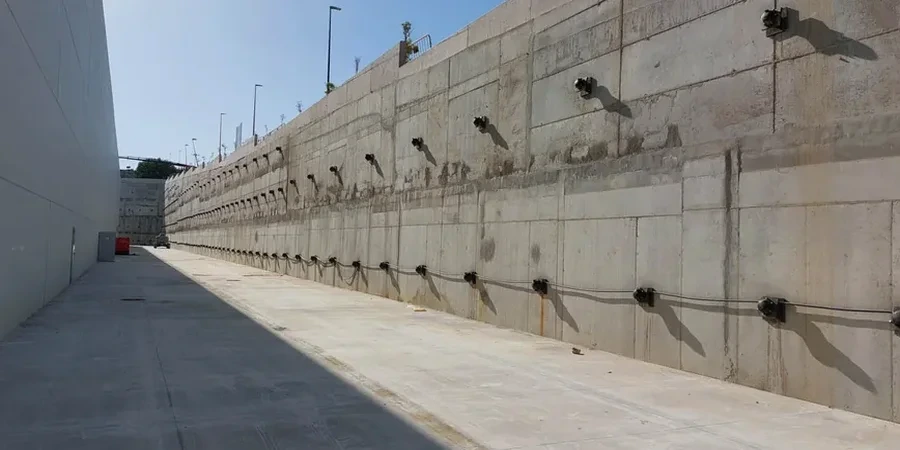
Full design package including tendon sizing, bond length calculation, and on-site supervision of the jacking and lock-off procedure for tied-back walls and tower foundations in Moncton.
Passive Anchor & Rock Bolt Design
Design of fully grouted passive anchors for slope stabilization and rockfall protection, with detailed pull-out capacity verification based on field investigation data.
Anchor Load Testing & Integrity
Performance, proof, and extended creep testing to validate design assumptions, plus lift-off tests on existing anchors to assess residual load in Moncton's aging infrastructure.
Common questions
What is the difference between an active and a passive anchor?
An active anchor is prestressed to a defined lock-off load immediately after installation, actively applying a compressive force to the structure. A passive anchor is fully grouted and only develops resistance as the ground deforms. In Moncton's soft clays, active anchors give us immediate control over wall deflection.
How much does an anchor design cost in Moncton?
For a typical anchored system, the design package—including load diagrams, construction specifications, and one site visit during stressing—falls between CA$1,260 and CA$4,770, depending on the number of anchor rows and the complexity of the soil profile.
What testing do you require before installing anchors?
We need at minimum one SPT or CPT sounding at the anchor location to define the bond zone stratigraphy. For critical structures, we also run a sacrificial anchor test to verify the ultimate bond stress before production drilling starts.
Can you design anchors for an existing retaining wall that is showing distress?
Yes. We inspect the wall condition, take core samples if needed, and design a retrofitting pattern of active anchors to restore lateral support. The challenge in Moncton is often accessing the rear of the wall when the backfill is saturated silty clay.