Moncton’s population has surged past 80,000, pushing new residential and industrial development into the city’s silty floodplain. The Petitcodiac River deposited these soft clays and silts over centuries, and they don't always react well to heavy axle loads. Before placing asphalt or concrete, you need a metric that quantifies the soil’s load-bearing capacity. The laboratory CBR test provides that number. Our team runs the soaked CBR procedure on remolded samples compacted at optimum moisture, simulating the worst-case spring thaw scenario that every Moncton road has to survive. We pair this data with field density checks using a sand cone density test to confirm that the contractor’s compaction effort matches the design assumptions, closing the loop between the lab and the job site.
The soaked CBR value is the single most important number in a Moncton pavement design. It tells you how the road will behave in April, not August.
Technical details of the service in Moncton
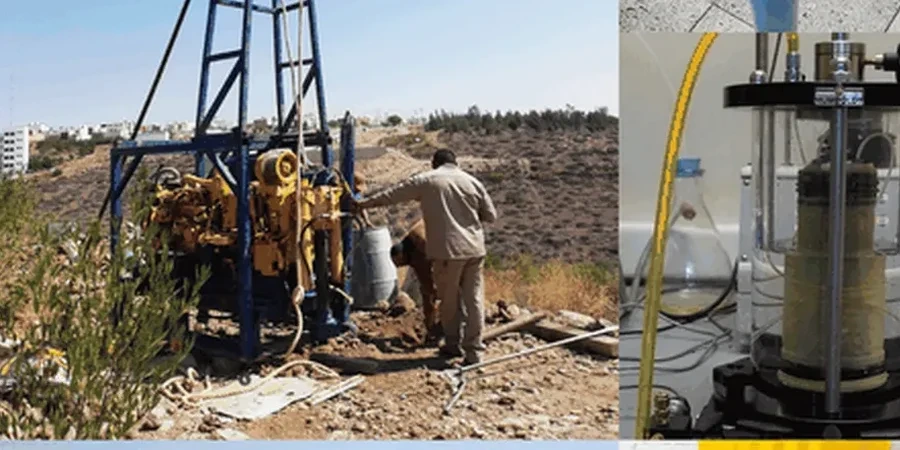
Critical ground factors in Moncton
The silty alluvial soils common along the riverbanks and the older glacial tills found toward Magnetic Hill create a split personality in Moncton’s subgrade. One section of a road might test at 12% CBR while the next drops to 3%. Ignoring that variation leads to differential settlement and fatigue cracking within the first three freeze-thaw cycles. The soaked CBR test forces the sample to absorb water for 96 hours, directly simulating the saturated conditions that follow a Moncton spring melt. If the soaked value falls below the structural design threshold, the pavement section must be thickened or the subgrade stabilized with lime or cement. Getting this wrong means the municipality or developer faces a full-depth reconstruction bill five years early. We have seen it happen on collector roads where the pre-design geotechnical investigation skipped the lab phase entirely.
Our services
Our Moncton soil lab handles the full CBR workflow, from sample preparation to the final signed report.
Soaked CBR Determination
We compact your subgrade or aggregate sample at optimum moisture content, submerge it for four days, and measure penetration resistance. The report includes load-penetration curves and the corrected CBR value at 0.1 and 0.2 inches, ready for your pavement design software.
Compaction Curve and CBR Package
A combined package that first establishes the moisture-density relationship (Proctor curve) and then runs three CBR points at varying moisture contents. This gives you a sensitivity curve showing how the bearing ratio drops if the material is compacted wet of optimum, a critical insight for Moncton’s rain-prone construction season.
Common questions
What does a laboratory CBR test cost in Moncton?
A single soaked CBR point, including the Proctor compaction curve, typically runs between CA$160 and CA$310 depending on the material type and the number of points required. Granular materials with large particles sometimes need a larger mold, which affects the price.
How long does the CBR test take from sample drop-off to report?
The standard turnaround is five to seven working days. The four-day soaking period is fixed, and we need one day for compaction and one day for the penetration test and reporting. We can expedite the report writing if the schedule is tight.
Can you test aggregate base material or only fine-grained soils?
We test both. For granular base course material with particles up to 3/4 inch, we use the standard 6-inch mold. If the material contains oversized particles, we scalp the sample on the No. 4 sieve and correct the result per ASTM D1883. We also run the test on cement-stabilized soils for industrial yard pavements.
Do I need the soaked or unsoaked CBR value for my Moncton project?
You need the soaked value. The City of Moncton’s standard drawings and most provincial specifications for New Brunswick require the 96-hour soaked CBR for pavement design. The unsoaked value is supplementary and rarely used for structural decisions in this climate. More info.