Compliance with the National Building Code of Canada (NBCC) and CSA A23.3 in the Moncton area demands a clear picture of the particle-size distribution, especially where silts and clays from the Petitcodiac River floodplain interact with coarser upland tills. Moncton’s average annual precipitation, hovering around 1,100 mm, combined with the region’s humid continental climate, means drainage and frost susceptibility are never an afterthought. A sieve analysis paired with a hydrometer test reveals the full curve — from gravel down to the colloidal fraction — which is the foundation for classifying the soil according to the Unified Soil Classification System (USCS). For sites near the tidal bore or along the Trans-Canada Highway corridor where cut-and-fill operations are routine, we find that skipping the hydrometer on fine-grained material leads to under-estimated frost heave potential. The laboratory team processes samples collected from test pits or SPT splits, ensuring the grain-size data feeds directly into compaction specs and bearing-capacity models without guesswork.
Moncton’s layered post-glacial soils demand the full curve — sieves alone miss the clay fraction that drives frost heave and consolidation settlement.
Technical details of the service in Moncton
Procedure video
Critical ground factors in Moncton
The contrast between Moncton’s downtown core, built on compact glaciofluvial sands near the river terrace, and the expanding residential subdivisions south of the Trans-Canada Highway, which sit on glaciolacustrine silts and soft clays, illustrates why grain-size data is non-negotiable. In the downtown area, a poorly graded sand may trigger a high permeability rating but still prove prone to internal erosion if the uniformity coefficient drops below 3 — something we catch when the sieve curve is too steep. Meanwhile, the silty-clay tracts in the south end retain moisture late into the spring, and without a full hydrometer analysis it is nearly impossible to predict the frost-susceptibility classification under the USCS. Moncton has experienced significant flooding events, most notably the 2010 and 2019 freshets along the Petitcodiac, and soil horizons that spent days submerged often exhibit altered fines content; post-flood grain-size checks give the engineer a defensible basis for revising foundation recommendations without starting from zero.
Our services
Our grain-size program in Moncton is built to support everything from pre-construction site characterization to QA/QC on earthworks, with two core service levels that match the typical project stages in the Greater Moncton Area.
Full mechanical sieve + hydrometer package
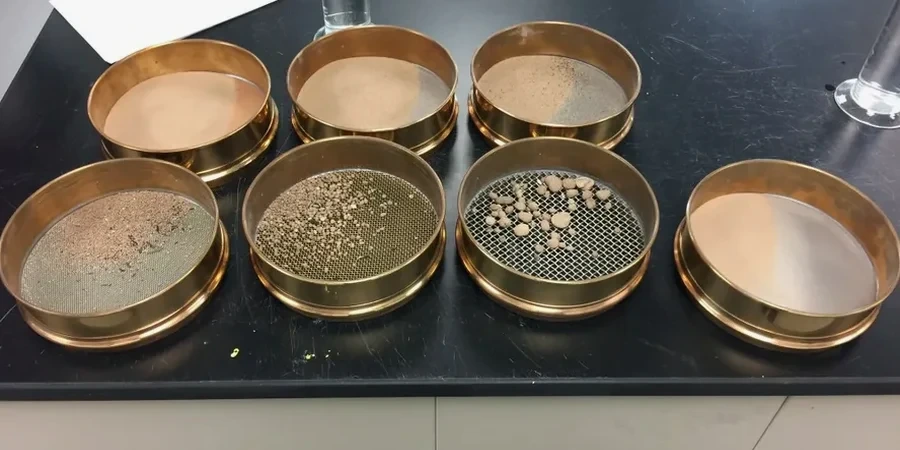
Covers the complete range from coarse gravel to colloidal clay. We run mechanical sieving on the coarse fraction (retained on the 75 µm sieve) and a hydrometer sedimentation analysis on the fines, applying ASTM D422/D6913. The report includes the particle-size distribution curve, uniformity coefficient (Cu), coefficient of curvature (Cc), and the percentages of gravel, sand, silt, and clay — formatted for direct insertion into geotechnical reports submitted to the City of Moncton’s building division.
Wash-sieve analysis for aggregate QA/QC
Focused on granular materials for road base, concrete aggregates, and filter media. We wash the sample over the No. 200 sieve to determine the fines content, then dry-sieve the retained material. This package is frequently requested for provincial highway projects and commercial pad preparation in the Moncton Industrial Park, where spec compliance hinges on a clean gradation envelope.
Common questions
What does a combined sieve and hydrometer test cost for a typical Moncton project?
For a single-sample full package — mechanical sieve plus hydrometer — the fee runs between CA$160 and CA$260, depending on whether the material is predominantly coarse or fine and how much prep time is needed to break down aggregations. Rush turnaround, multiple depth intervals from the same borehole, or projects requiring chain-of-custody documentation for environmental overlap can move the number toward the upper end. We always confirm the quote after seeing the sample condition and knowing the required reporting format.
How long does it take to get results back for a grain-size analysis in Moncton?
Standard turnaround is four to five business days from sample receipt. The hydrometer phase needs a minimum 24-hour sedimentation period, and oven-drying plus sieve shaking adds another day. If the project is on a tight tender schedule, we can prioritize the sieve portion within 48 hours and follow with the hydrometer data a day later, so the design team can start working with the coarse fraction immediately.
Why is the hydrometer test necessary if we already run a wash-sieve?
A wash-sieve tells you the total percentage passing the No. 200 sieve but says nothing about the split between silt-sized and clay-sized particles. In Moncton, where glaciolacustrine clays can make up a significant portion of that minus-200 fraction, the hydrometer is the only way to distinguish a frost-susceptible silt from a plastic clay that drives consolidation settlement. Without that split, the USCS classification is incomplete, and the foundation design may be based on an overly optimistic soil description.