Moncton sits on sedimentary bedrock of the Carboniferous Pictou Group, overlain by significant thicknesses of compressible marine clays and silts deposited by the historical Petitcodiac River estuary. This soil profile, with shear wave velocities often below 180 m/s in the upper 15 meters, amplifies ground motion during seismic events and creates a class E site condition under NBCC 2020. Base isolation seismic design addresses this amplification directly by decoupling the superstructure from the ground, shifting the fundamental period of the building away from the dominant spectral peak of the site. For critical infrastructure in the downtown core—where the water table is typically less than 2 meters below grade—combining isolation bearings with a seismic microzonation study refines the site-specific response spectra and reduces the conservatism inherent in code-based static analysis.
A properly tuned base isolation system in Moncton can reduce base shear demands by 60 to 75 percent compared to a conventional fixed-base structure, transforming a class E site from a liability into a manageable design condition.
Technical details of the service in Moncton
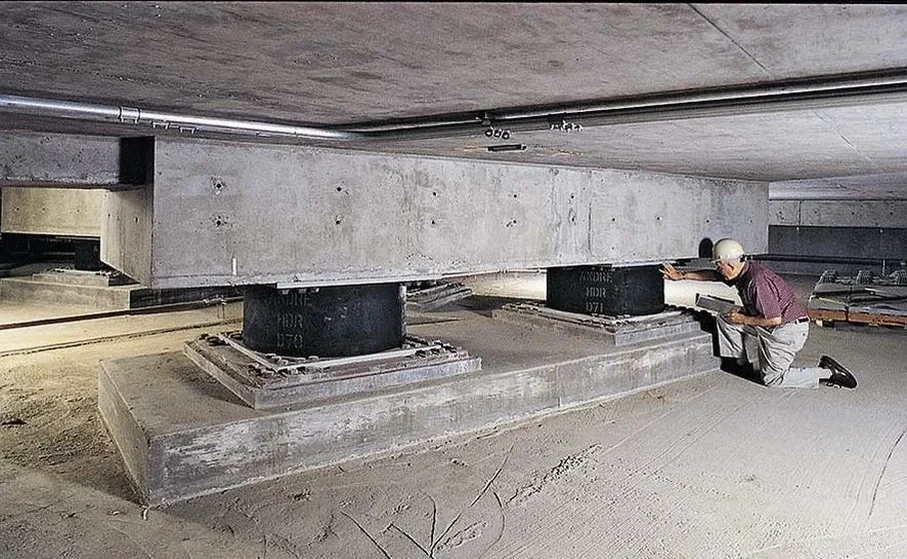
Critical ground factors in Moncton
Moncton’s uniform hazard spectrum, as defined in NBCC 2020, assigns a PGA of approximately 0.12g for a 2% in 50-year probability—moderate by global standards, yet the site amplification on class E soils can multiply spectral accelerations at periods of 0.5 to 1.0 seconds by factors exceeding 2.5. A conventional fixed-base concrete shear wall building on these soils risks developing a soft-story mechanism if the period elongation during nonlinear response aligns with the amplified spectral peak. Base isolation seismic design mitigates this by shifting the structural period well beyond the amplified range, into the displacement-controlled region of the spectrum. The 2011 Christchurch earthquake in New Zealand provided stark evidence of how basin-edge effects in sedimentary valleys can concentrate energy, a scenario that the deep Petitcodiac trough could replicate under a magnitude 5.5 event at shallow depth—making the isolation of post-disaster recovery buildings a prudent investment.
Our services
Our Moncton base isolation seismic design service integrates local geotechnical knowledge with advanced structural dynamics. Each project begins with a site-specific hazard assessment and proceeds through isolator selection, nonlinear modeling, and peer review coordination.
Isolation System Concept Design
Comparative analysis of lead-rubber bearing, friction pendulum, and high-damping rubber isolator configurations for Moncton buildings, optimizing for the 2,500-year return period spectral demand while respecting the ±400 mm displacement capacity of typical isolator units.
Nonlinear Response History Analysis
Three-dimensional NLTHA modeling in ETABS or SAP2000 with 11 ground motion pairs—spectrally matched to the site-specific target spectrum derived from NBCC 2020 and local soil amplification factors—to verify performance at the MCE and DBE hazard levels.
Peer Review & Compliance Documentation
Preparation of design criteria reports, isolator prototype test specifications per CSA A23.3 Annex N, and responses to municipal building official review comments for Moncton projects requiring alternative solution submissions under the local building by-law.
Common questions
What is the typical cost range for base isolation seismic design on a mid-rise building in Moncton?
For a typical 4 to 6-story commercial or institutional building in Moncton, the engineering design fees for a complete base isolation package—including concept design, nonlinear time-history analysis, and peer review documentation—fall between CA$5,660 and CA$9,950. The final figure depends on the structural irregularity of the building, the number of ground motion suites required by the peer reviewer, and whether a site-specific seismic hazard study is needed.
Does the NBCC 2020 require base isolation for buildings in Moncton?
The NBCC 2020 does not mandate base isolation for any specific building type; it permits it as an alternative solution to conventional force-based design. However, for post-disaster buildings (hospitals, emergency operations centers) and high-importance structures on class E sites in Moncton, base isolation often becomes the most cost-effective method to achieve the enhanced performance objectives required under Clause 4.1.8.12, particularly when the owner demands immediate occupancy after the design earthquake.
How do you account for the soft marine clays under Moncton when designing base isolators?
The compressible clays influence the foundation design rather than the isolators directly. We commission a site-specific geotechnical investigation with shear wave velocity profiling to confirm the site class. If deep piles are required to control settlement under the rigid base slab below the isolators, we model the pile-soil-structure interaction, accounting for rotational stiffness at the isolation interface. This ensures the isolator displacement demand calculations include the kinematic effects of foundation flexibility on the class E profile common near the Petitcodiac River.
What isolator types work best for the seismic hazard in Moncton?
Lead-rubber bearings (LRBs) are often preferred for Moncton projects because their characteristic strength provides wind-braking resistance under service loads—useful given the city’s exposure to Atlantic storm winds—while their hysteretic damping (typically 25-30%) is effective at the moderate displacement amplitudes expected. Friction pendulum systems (FPS) become advantageous for lighter structures or where a longer effective period is needed, as their period is independent of the supported mass.
How long does a base isolation design and peer review take for a Moncton project?
A typical base isolation design package for a Moncton building progresses through three phases: concept design and isolator selection (4-5 weeks), detailed nonlinear modeling and response history analysis (5-7 weeks), and peer review coordination with response to comments (3-4 weeks). The total timeline of 12 to 16 weeks can compress if the geotechnical investigation and site-specific hazard study are completed in parallel during the schematic design phase.