A crew was drilling near the Gunningsville Bridge approach last fall. The project hit a layer of soft, grey clay at 4 meters. Without reliable SPT data, the risk of differential settlement would have been significant. That is the reality of the Moncton substrate. Our team sees this daily in the Petitcodiac basin. The Standard Penetration Test in Moncton is not just a routine procedure. It is the direct method to measure the resistance of compressible silts and clays found throughout the city. We correlate each SPT blow count with local background in the Triassic red beds. The result is a bearing capacity calculation you can trust. This eliminates guesswork from your deep foundation design. Before finalizing your geotechnical campaign, consider how a detailed grain size analysis complements the SPT data for classifying these fine-grained soils.
An SPT in Moncton's estuarine clays must capture the sample's structure before it remolds. That is the difference between a safe design and a costly repair.
Technical details of the service in Moncton
Critical ground factors in Moncton
The Petitcodiac River's tidal bore creates a unique challenge. The water table fluctuates sharply. This saturates the fine-grained soils and lowers their effective stress. A standard SPT in Moncton must consider this seasonal water content. Dry-season blow counts can paint an overly optimistic picture if the groundwater is not monitored. The sensitive marine clays also lose up to 80% of their strength when disturbed. A low N-value in these clays is a clear warning sign. Ignoring it leads to excessive settlement under load. We also check for the presence of boulders in the basal till. A sudden refusal can be mistaken for bedrock. Our experienced drillers recognize the difference. They know the local stratigraphy. This prevents premature termination of the borehole and ensures the pile toe reaches competent material.
Our services
Our Moncton SPT service is part of a complete geotechnical investigation package. We coordinate the field work, laboratory testing, and engineering analysis to deliver a smooth report.
Field Drilling & Sampling
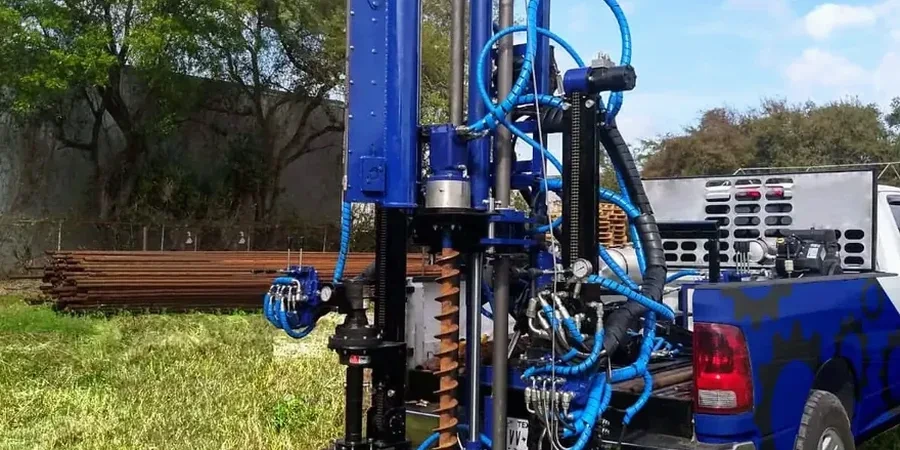
We mobilize our track-mounted drills to your Moncton site. We advance the borehole with hollow-stem augers through the overburden. Our crew logs every spoon sample and measures the groundwater.
SPT Data Interpretation
We correct the raw N-values for overburden pressure and hammer energy. We use the corrected N60 to estimate the friction angle in sands and the undrained shear strength in clays.
Foundation Recommendations
We translate the SPT results into allowable bearing pressures for footings and skin friction values for piles. Our report includes a complete geotechnical model of the subsurface.
Common questions
What is the typical cost of a Standard Penetration Test in Moncton?
For a standard SPT borehole in the Moncton area, the cost generally ranges from CA$790 to CA$910 per borehole. This includes the mobilization of the drilling rig, the field crew, and the logging of the soil samples. The final price depends on the total depth, the number of boreholes, and the access conditions on your site.
How does the SPT help with foundation design in the Moncton basin?
The SPT gives us a direct measure of the soil's density and consistency. In the basin's soft clays, a low N-value tells us the soil is sensitive and will consolidate under load. We use this data to calculate how much a footing will settle and to decide if a deep pile foundation is necessary.
How long does an SPT field investigation take?
A single borehole to a depth of 15 meters typically takes one day to drill, sample, and backfill. For a larger project with multiple boreholes, the field work might take three to five days. We then need about one to two weeks to complete the laboratory testing and prepare the geotechnical report.
Do you correct the SPT N-values for the soil type found in Moncton?
Yes. We apply the standard corrections for overburden pressure and hammer energy ratio. For the sensitive clays common in this region, the corrected N60 value is the key parameter we use to estimate the undrained shear strength and the preconsolidation pressure.